Choosing the right college is one of the most important decisions of your life. Yet, most students and parents make this decision based on word-of-mouth, proximity, or last-minute availability — without ever systematically evaluating whether a college is truly worth their time and money.
If you are asking how to evaluate a college before admission, you are already ahead of the curve. This guide covers 12 essential college evaluation criteria that every student in India should verify before submitting that admission form — so you don’t end up regretting a choice you made in a hurry.
Why Evaluation Before Admission is Critical
India has over 45,000 colleges affiliated to various universities. Not all of them deliver quality education. Many colleges operate with outdated infrastructure, underqualified faculty, or zero placement support. A poor college choice can cost you:
- 3–4 years of precious time
- Lakhs of rupees in fees
- Career opportunities and industry exposure
- Mental well-being due to poor environment
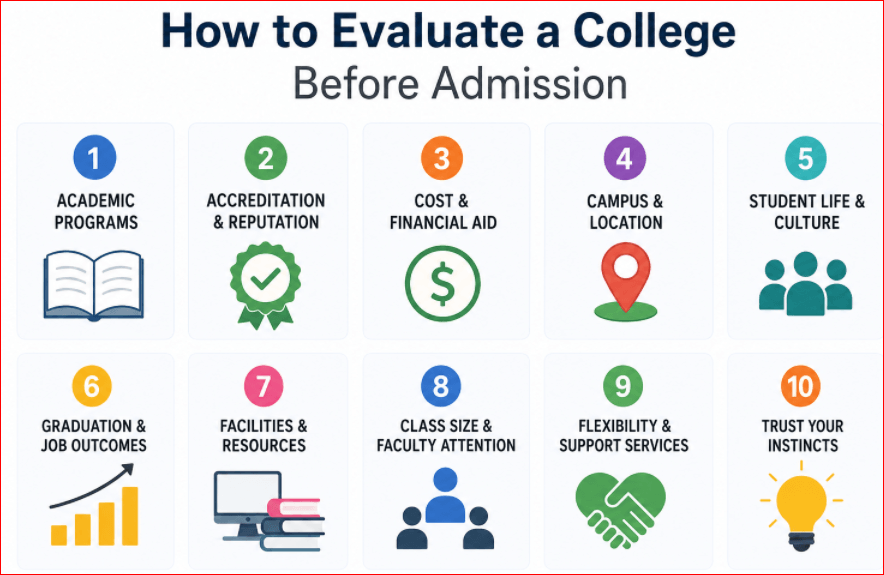
Doing thorough college evaluation before admission ensures you invest in a place that will actually help you grow academically and professionally. Here is your complete college admission checklist — 12 things to check before joining any college.
1. NAAC Accreditation Grade
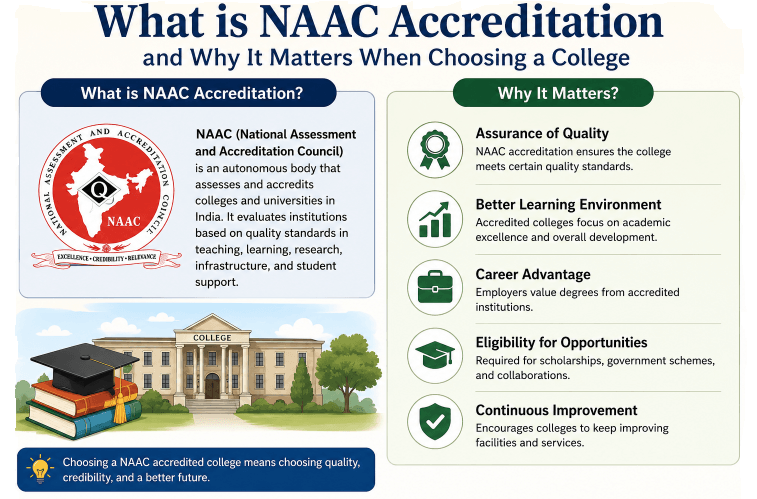
The National Assessment and Accreditation Council (NAAC) evaluates colleges on academic quality, infrastructure, faculty, and governance. A NAAC grade is one of the most reliable indicators of institutional quality in India.
| NAAC Grade | CGPA Range | What It Means |
|---|---|---|
| A++ | 3.51 – 4.00 | Outstanding – Top-tier institution |
| A+ | 3.26 – 3.50 | Excellent – Highly recommended |
| A | 3.01 – 3.25 | Very Good – Good choice |
| B++ | 2.76 – 3.00 | Good – Acceptable with caution |
| B+ | 2.51 – 2.75 | Average – Verify other factors |
| B / C | Below 2.50 | Below Average – Reconsider carefully |
| Not Accredited | N/A | ⚠️ Major Red Flag |
✅ Action: Visit naac.gov.in and search the college name to check its current accreditation status and validity year.
2. NIRF or State Ranking
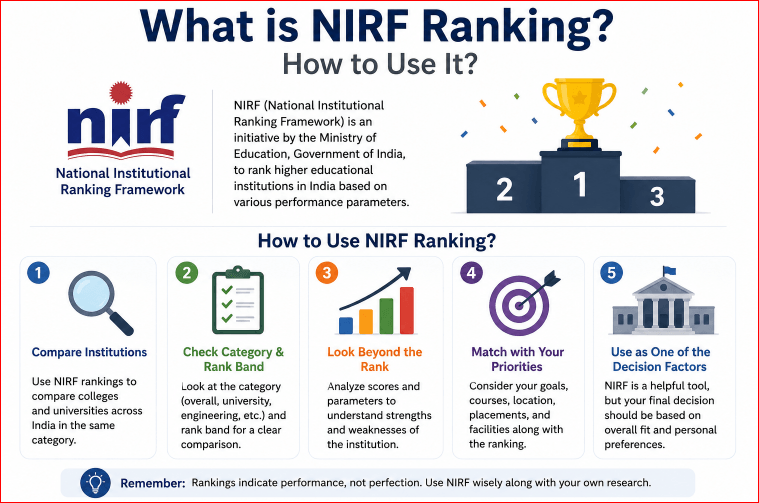
The National Institutional Ranking Framework (NIRF), published annually by the Ministry of Education, ranks institutions across India based on Teaching, Learning & Resources, Research, Graduation Outcomes, and Peer Perception.
If a college appears in the NIRF Top 200 for its category (Engineering, Management, Arts, etc.), that is a strong sign of institutional credibility. For state-level colleges, check rankings published by the respective State Higher Education Councils.
✅ Action: Visit nirfindia.org and filter by your preferred discipline and state.
3. University Affiliation and Recognition
Not every college is legally recognised. Before finalising, confirm the following:
- Is the college affiliated to a UGC-recognised university?
- Is the college listed on the UGC website as an approved institution?
- Is it approved by the relevant statutory body? (e.g., AICTE for engineering, BCI for law, MCI/NMC for medical)
- Is the university State, Central, or Deemed? Deemed universities vary significantly in quality.
⚠️ Warning: Degrees from non-UGC-recognised colleges or fake universities are legally invalid for government jobs and higher studies.
✅ Action: Cross-check at ugc.gov.in → “Approved Institutions” list.
4. Faculty Qualifications and Student-Teacher Ratio
The quality of your education is directly tied to the quality of those teaching you. When evaluating faculty:
- Check how many faculty members hold a Ph.D. or NET/SET qualification
- Look at the student-to-teacher ratio — ideally below 20:1 for quality interaction
- Check for guest/adjunct faculty vs. permanent faculty ratio
- Look for faculty with industry experience, especially for professional courses
| Student-Teacher Ratio | Quality Indication |
|---|---|
| Below 15:1 | ✅ Excellent – Personalised attention likely |
| 15:1 to 25:1 | 🟡 Acceptable |
| 25:1 to 40:1 | 🟠 Below Average – Ask questions |
| Above 40:1 | 🔴 Red Flag |
✅ Action: Ask the admissions office for the faculty list with qualifications. Many NAAC Self-Study Reports (SSRs) also publish this data publicly.
5. Placement Cell and Company Visits
For professional and technical courses, the placement record is the ultimate test of a college’s real-world value. Do not rely on brochure claims — dig deeper.
Questions to ask the placement cell:
- What is the average and median CTC offered in the last 3 years?
- What percentage of students got campus placements (not internships)?
- Which companies visited? Are they product/service companies or just staffing agencies?
- Are placement statistics third-party verified?
⚠️ Red Flag: If a college only mentions the highest package and not the average, or if all recruiters are unknown companies, be very cautious.
6. Hostel and Campus Facilities
If you are moving away from home, the hostel and campus environment will directly affect your health, focus, and overall experience. Always do a physical campus visit before admission.
Check for:
- Separate and secure hostels for boys and girls
- Quality of mess food and hygiene standards
- 24-hour water and power supply (with backup)
- Wi-Fi connectivity across campus
- Medical facilities or tie-up with nearby hospital
- Security arrangements (CCTV, guards, visitor policy)
✅ Tip: Visit the campus unannounced or during a non-event day to see the real condition of facilities.
7. Library and Laboratory Infrastructure
Academic infrastructure is a key part of any college evaluation criteria. Outdated labs and an understocked library signal that the college is not investing in student development.
| Infrastructure | What to Check |
|---|---|
| Library | Number of titles, journals, digital databases (DELNET, JSTOR, etc.), e-library access |
| Science / Engineering Labs | Equipment year, working condition, availability of consumables, lab-to-student ratio |
| Computer Labs | Modern hardware, licensed software (AutoCAD, MATLAB, etc.), internet speed |
| Seminar / Conference Halls | Seating capacity, AV equipment, regular usage for events |
| Innovation / Research Centre | Presence of incubation centre, patents filed, research funding |
8. Student Reviews on Google and Portals
One of the most honest sources of information about a college is what current students and alumni say online. Check multiple platforms for an unbiased picture.
Where to look:
- Google Maps – Check star rating and read recent reviews (filter by “Newest”)
- Shiksha.com – Detailed reviews by students, course-wise
- Collegedunia.com – Placement reviews, infrastructure ratings
- Google / Quora – Search “[College Name] honest review” or “[College Name] placement fake”
- LinkedIn Alumni – Check where graduates from this college currently work
⚠️ Caution: Ignore suspiciously over-positive reviews with no details. Look for pattern in criticism — repeated complaints about the same issue are a warning sign.
9. Fee Structure and Hidden Charges
Fee transparency is a hallmark of trustworthy institutions. Many students are caught off guard by additional charges not disclosed at the time of admission.
Always ask for a complete fee breakup in writing, including:
| Fee Component | Ask About |
|---|---|
| Tuition Fee | Per semester or per year? Any annual increase policy? |
| Development / Infrastructure Fee | Mandatory or optional? What does it cover? |
| Examination Fee | Separate from tuition? Per exam? |
| Hostel + Mess Fee | Included or extra? What is the mess quality? |
| Library / Lab Fee | Refundable deposit required? |
| Uniform / Materials | Compulsory purchase from college? |
| Placement / Internship Fee | Any charge for placement process? |
✅ Tip: Check if the college is eligible for scholarships (SC/ST, OBC, merit-based, state government) and if the financial aid process is transparent.
10. Extracurricular and Sports Facilities
A college education is not just about academics — your overall personality, communication, teamwork, and leadership grow through extracurricular activities. These also matter significantly to top employers.
Things to check:
- Is there a dedicated sports ground and gymnasium?
- Are there active student clubs (cultural, technical, literary, entrepreneurship)?
- Does the college participate in inter-collegiate events like youth festivals, hackathons, sports meets?
- Is there an NSS/NCC chapter?
- Are there any student-run magazines, radio stations, or social media handles?
Colleges that invest in extracurriculars signal a healthy campus culture that supports holistic development.
11. Distance from Home / Transport Connectivity
While this may seem secondary, the location and accessibility of a college has a very real impact on your daily life, especially if you are a day scholar.
Consider:
- Distance from home – Can you commute daily, or will you need a hostel?
- Public transport availability – Bus routes, metro connectivity, auto availability
- College transport / bus service – Does the college offer bus routes from major stops?
- Safety of the area – Especially important for female students
- Access to city amenities – Hospitals, markets, coaching centres nearby
A college 5 hours away may sound fine during admission season but can be exhausting over 3–4 years.
12. Alumni Network and Career Support
A strong alumni network is one of the most underrated college evaluation criteria. Alumni open doors to internships, referrals, mentorship, and even funding for startups.
How to evaluate the alumni network:
- Search the college name on LinkedIn — where are alumni working? At what level?
- Does the college have an active alumni association with regular events?
- Are there alumni mentorship programmes for current students?
- Does the college have a Career Development Centre (CDC) beyond just placements?
- Are there tie-ups with organisations like NASSCOM, CII, industry bodies?
Red Flags That Should Make You Reconsider
Here is a quick list of warning signs that suggest you should think twice before joining a college — no matter how convincing the brochure looks:
- 🚩 No NAAC accreditation or accreditation expired more than 3 years ago
- 🚩 Not listed on UGC/AICTE website as an approved institution
- 🚩 College pressures you to pay full fees immediately before issuing any receipt
- 🚩 Refuses to share placement data or evades specific questions about recruiters
- 🚩 Excessive negative reviews on Google Maps and student portals about the same issues
- 🚩 Faculty roster is full of temporary/visiting faculty with no permanent appointments
- 🚩 Campus looks poorly maintained or deserted during a weekday visit
- 🚩 No active student clubs, sports, or cultural events on record
- 🚩 College is under a court case, UGC show-cause notice, or state government inquiry
- 🚩 Admitted under management quota with no transparency on seat allocation
Quick Evaluation Checklist Table
Use this college admission checklist when visiting or researching any college before admission:
| # | Evaluation Criteria | Where to Check | Status |
|---|---|---|---|
| 1 | NAAC Accreditation Grade (A or above) | naac.gov.in | ☐ Done |
| 2 | NIRF / State Ranking | nirfindia.org | ☐ Done |
| 3 | UGC / AICTE Recognition | ugc.gov.in / aicte-india.org | ☐ Done |
| 4 | Faculty Qualifications & Student-Teacher Ratio | College SSR / Admissions Office | ☐ Done |
| 5 | Placement Records (Average CTC, Companies) | Placement Cell / Alumni / LinkedIn | ☐ Done |
| 6 | Hostel & Campus Facilities (Physical Visit) | Campus Visit | ☐ Done |
| 7 | Library, Labs & Infrastructure | Campus Visit / NAAC SSR | ☐ Done |
| 8 | Student Reviews (Google, Shiksha, Collegedunia) | Online Platforms | ☐ Done |
| 9 | Complete Fee Structure (No Hidden Charges) | Admissions Office (Written) | ☐ Done |
| 10 | Sports & Extracurricular Activities | Campus Visit / College Website | ☐ Done |
| 11 | Location & Transport Connectivity | Google Maps / Personal Assessment | ☐ Done |
| 12 | Alumni Network & Career Development Cell | LinkedIn / College Website | ☐ Done |
Knowing how to evaluate a college before admission is a skill that can literally change the trajectory of your career. Too many students treat college admission as a formality — filling seats rather than making strategic life investments.
Take the time to verify accreditation, visit the campus, talk to current students, and cross-check placement data before writing that fee cheque. The right college will challenge you, support you, and connect you — the wrong one will simply take four years of your life.
Use the college admission checklist above as your go-to tool when shortlisting institutions. A few hours of research today can save you years of regret tomorrow.
Have a question about evaluating a specific college or course? Drop it in the comments below — we are happy to help!
Latest Blog Post





How to Choose the Right College After 12th in India
06 Jun, 2026