Every year, millions of Indian students pick a college the same way — by matching their percentage to a cutoff list and joining whatever takes them. It is an understandable shortcut under pressure, but it is also the reason so many graduates spend years in careers they never wanted, working in industries their college had no connection to whatsoever.
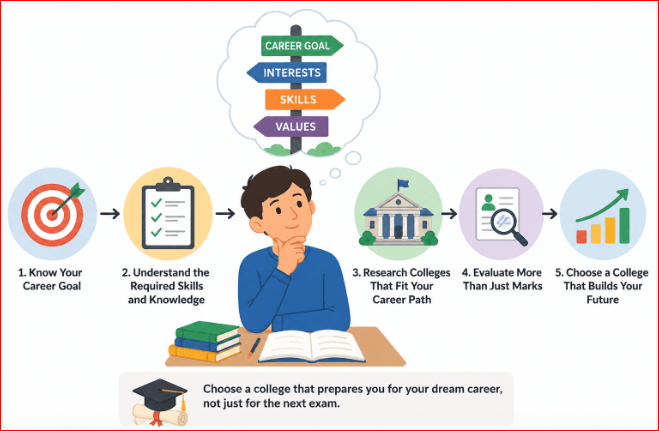
Marks tell you what you qualified for. They say nothing about what you actually want to do with the next forty years of your working life. Choosing a college based on your career goal — rather than just your score — is a fundamentally different process, and this guide walks you through it step by step.
Why Marks Alone Are a Bad Way to Pick a College
The marks-based selection model has one core flaw: it treats colleges as interchangeable within a score band. If you scored 82%, you pick from whatever colleges fall in the 78–85% cutoff range — without asking whether any of them actually serve the career you are aiming for.
Here is what that approach costs you:
It ignores college specialisation. A college ranked mid-tier overall might have an exceptional journalism department, a nationally known law school, or a design programme with strong industry connections. A top-ranked college might have a weak department in exactly the specialisation you need. Marks-based selection erases all of that nuance.
It confuses prestige with fit. A prestigious college in the wrong discipline is less useful to your career than a focused, industry-connected college in the right one. A student who wants to work in civil services is not served by an average engineering college — regardless of its overall ranking.
It ignores alumni networks and industry linkages. Some colleges have deep, long-standing relationships with specific industries — media houses, law firms, hospitals, or tech companies. These relationships directly translate into internships, campus placements, and referrals. A college strong in your target industry is worth far more than a generically prestigious one with no connections there.
The right question when choosing a college is not “What college will take my score?” — it is “What college will get me closest to the career I want?”
Step 1: Define Your Career Goal First
Before you research a single college, spend time on this step — because everything else depends on it. You do not need a fully formed five-year plan. You need enough clarity to answer one question: what kind of work do you want to do?
Start with these prompts:
- What subjects or activities have consistently held your attention without feeling like effort?
- Which professional fields do you find yourself reading about, watching videos on, or discussing — without being asked to?
- What kind of environment do you want to work in — a courtroom, a hospital, a newsroom, a tech company, a government office, a design studio?
- Do you see yourself working for an organisation, or building one?
- Which careers are common among people you genuinely admire?
You do not need a single definitive answer at this stage. Narrowing down to two or three career directions is enough to begin the college search intelligently. Write them down. Everything from here flows out of that list.
Step 2: Map Your Career Goal to the Right Degree
India’s education system has a tendency to push students toward a default degree — engineering by default for science students, CA or BBA for commerce students, BA for arts students — without asking whether those degrees actually lead to the career in question.
Many careers in India can be reached through more than one degree path, and some popular degrees are actually poor fits for the careers students associate with them. Here is how the mapping works in practice:
| Career Goal | Most Direct Degree | Alternative Degree Path | Common Mistake |
|---|---|---|---|
| Software Engineer / Product Manager | B.Tech Computer Science | B.Sc IT + strong portfolio | Joining any B.Tech college regardless of CS placement track |
| Civil Services (IAS/IPS) | BA / B.Sc (any discipline) + UPSC prep | B.Tech + UPSC prep | Thinking the degree subject determines UPSC success |
| Corporate Lawyer | BA LLB (5-year integrated) | LLB after graduation | Picking a law college without checking Bar Council recognition |
| Doctor (Clinical) | MBBS + PG specialisation | No true alternative for clinical medicine | Joining a private medical college without NMC approval |
| Finance / Investment Banking | B.Com + CA / MBA Finance | B.Sc Economics + MBA | Expecting a generic BBA to lead to investment banking |
| Journalist / Content Strategist | BA Mass Communication / BA Journalism | BA English + portfolio-building | Ignoring placement track and industry connections of media colleges |
| Product Designer / UX Designer | B.Des (NID, NIFT, CEED colleges) | B.Tech + self-taught design portfolio | Assuming any design college has industry-level training |
| Entrepreneur / Startup Founder | Any degree from college with strong incubation centre | BBA / B.Tech at innovation-focused college | Assuming degree subject determines entrepreneurial success |
| School / College Teacher | B.Sc / BA + B.Ed | Integrated B.A. B.Ed programmes | Completing a degree without planning for B.Ed requirement |
| Government Job (SSC/Banking) | Any UG degree from recognised university | Any stream — focus is on exam prep | Spending on expensive college when degree stream doesn’t affect eligibility |
Step 3: Find Colleges Strong in That Career Track
Once you know which degree you need, the next question is: which colleges are genuinely strong in that specific career track — not just strong in general?
Here is how to find them:
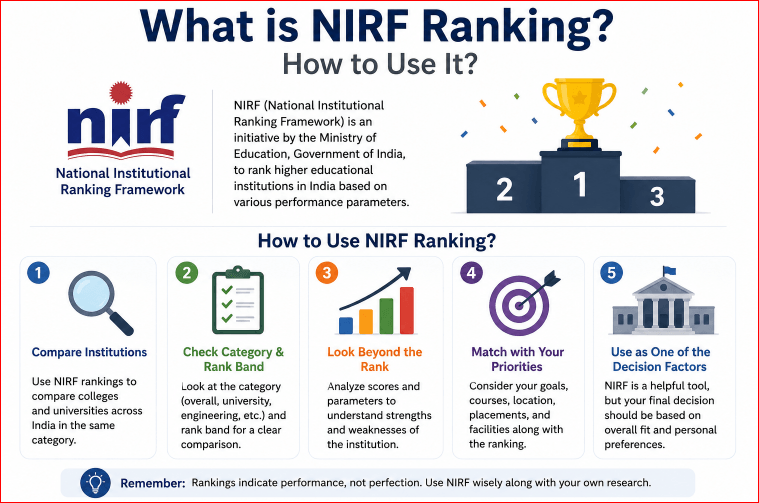
Use NIRF Category Rankings. Go to nirfindia.org and filter by your specific category — Engineering, Law, Management, Medical, etc. A college ranked 15 in Law is a far more specific signal than a college ranked 50 Overall.
Search LinkedIn by company, not by college. If you want to work at a specific type of company — a top law firm, a hospital, a media house, an investment bank — search for employees at that company on LinkedIn and filter by their educational background. This tells you which colleges these employers actually hire from.
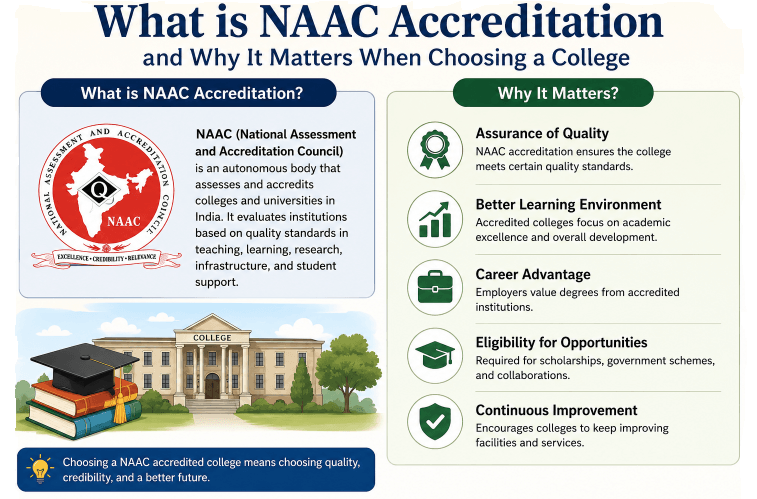
Read NAAC Self-Study Reports (SSRs). SSRs are public documents that colleges submit to NAAC before assessment. They contain detailed data on faculty, research, placement outcomes, and industry MoUs — far more granular than anything on the college website.
Ask domain-specific communities. Quora threads, subreddits (r/Indian_Academia, r/LawSchoolIndia), and Telegram groups for specific entrance exams often have frank, experience-based recommendations for colleges in a particular field.
Step 4: Check the Industry Connect of the College
A college’s relationship with its relevant industry is one of the strongest predictors of career outcomes for its students. Industry connect shows up in several verifiable ways:
- Guest lectures and masterclasses — Are practitioners from the industry regularly invited to campus? Check the college’s event calendar or social media for the last 12 months.
- MoUs with companies or professional bodies — Does the college have formal agreements with industry organisations? NAAC SSRs list these explicitly.
- Live projects and internship pipelines — Some colleges have structured internship arrangements with specific firms, not just open-ended “apply yourself” guidance.
- Industry-relevant curriculum updates — Autonomous colleges can revise their syllabus more frequently. Does the curriculum reflect what the industry actually uses today, or is it five years behind?
- Faculty with industry experience — In professional fields like management, law, and media, faculty who have worked in the industry bring a different quality of teaching than those who went directly from student to professor.
Step 5: Alumni Placement in Your Target Industry
This is the most direct evidence of whether a college will actually deliver on its career promises. Alumni outcomes are facts, not projections.
How to audit a college’s alumni placement in your target industry:
- Go to LinkedIn and type the college name in the search bar
- Click on the college’s LinkedIn page and select “Alumni”
- Use the filters to narrow by industry, company, or job title relevant to your target career
- Check how many alumni are in your target field — and at what level (entry, mid, senior)
- Look at the graduation years of those alumni — are recent graduates (last 3 years) entering your target industry, or only older alumni from more favourable market conditions?
If a college claims strong placements in a field but LinkedIn shows almost no alumni in that industry, you have found a significant gap between marketing and reality.
Career-to-College Mapping Table
Here is a broader reference table mapping common career directions in India to the types of colleges best positioned to support them:
| Stream | Career Direction | Type of College to Prioritise | Key Indicator to Check |
|---|---|---|---|
| Engineering | Software / Product / Data | NIRF Top 50 Engineering, NIT, IIIT | CS branch placement data, tech company recruiters |
| Core Engineering (Civil, Mech, Electrical) | College with PSU tie-ups, GATE coaching culture | GATE toppers from alumni, PSU recruitment history | |
| Entrepreneurship / Startups | College with active incubation centre (TIDE, ATAL) | Number of funded startups from campus | |
| Medical | Clinical Specialist (Doctor) | NMC-approved with strong PG seat record | NEET PG rank of alumni, hospital tie-ups |
| Public Health / Research | College affiliated to research hospital or ICMR centre | Research publications, fellowship placements | |
| Law | Litigation / Judiciary | BCI-recognised NLU or state law college near High Court city | Moot court record, judicial exam clearing rate |
| Corporate Law / Legal Advisory | NLU or autonomous law school with law firm recruiter visits | Top-tier law firm placement in alumni | |
| Commerce | CA / Finance | College with strong ICAI pass rate, Big 4 campus visits | CA final pass percentage of alumni, CA articleship pipeline |
| Banking / Insurance | Any UGC-recognised college with IBPS/SBI exam prep culture | Alumni in PSU banking roles | |
| Arts / Humanities | Civil Services | College near coaching hub (Delhi, Allahabad) or with UPSC study culture | Alumni in IAS/IPS/IFS roles |
| Media / Communication | Mass communication colleges with media house MoUs | Internship placements at news organisations, agencies |
What If You Don’t Know Your Career Goal Yet?
This is far more common than anyone admits — and it is a completely reasonable position for an 18-year-old to be in. The mistake is pretending you have clarity you do not have, and making a four-year commitment based on it.
If you are genuinely unsure, here is the most practical approach:
Choose a broad, flexible degree from a strong general institution. A BA with multiple subject options, a B.Sc, or a B.Com from a well-accredited, multi-disciplinary university gives you the most room to discover your direction without closing doors. Avoid highly specialised professional degrees (engineering, medicine, law) if you have no conviction about those fields — the cost of switching is very high.
Spend your first year exploring, not drifting. Take up internships, attend industry talks, volunteer in organisations in fields you are curious about, and take free online courses in areas that interest you. Most students who figure out their direction during college do so through exposure, not introspection alone.
Delay the specialisation, not the thinking. You do not need to commit to a specific career in year one, but you should be actively narrowing down your options — not passively waiting for clarity to arrive. Use the career-to-college mapping table above as a reference to understand what each path actually requires, so when clarity comes, you know what to do with it.
Know that postgraduate study resets some options. Many Indian careers can be entered or redirected through a strong postgraduate choice — an MBA, LLB, M.Sc, or M.Tech. If your undergraduate degree is from an accredited, credible institution with decent marks, postgraduate entrance exams give you a second, more informed shot at career-oriented college selection.
How to Research Career Outcomes of a Specific College
Once you have a shortlist, here is a structured process to evaluate each college’s actual career outcomes — not just their claimed ones:
- LinkedIn Alumni Audit — Filter alumni by industry and graduation year as described in Step 5. Look at recent graduates specifically.
- NAAC SSR Download — Go to naac.gov.in, find the college’s latest assessment report, and locate Criterion 5 (Student Support & Progression). It contains placement data that was submitted to an external body for verification.
- NIRF Score Card — On nirfindia.org, check the Graduation Outcomes (GO) sub-score specifically. This reflects placement rate and median salary as reported to the Ministry of Education.
- Direct Conversation With Final-Year Students — Find students through the college’s social media, alumni groups, or the college’s own WhatsApp/Telegram communities. Ask them directly: how many people in your batch have offers? From which companies? What was the process actually like?
- Check the Placement Cell’s Own Social Media — Many placement cells post offer letters and recruiter visit announcements on their Instagram or LinkedIn. This gives you a real-time, unfiltered view of who is actually coming to campus.
FAQ: Career-Based College Selection
Q1. Can I change my career path after joining a college?
Yes — and many students do. But the cost of changing direction increases with each year you spend in a specialised programme. The earlier you identify a mismatch, the more options you have. This is exactly why it is worth doing the career thinking before admission rather than after.
Q2. Should I prioritise college reputation over course fit?
Generally, no. A respected college with a weak department in your intended field will serve you less well than a focused, industry-connected college that is known for precisely that specialisation. Reputation matters most when it is tied directly to your target industry — not as a generalised brand.
Q3. My parents want me to do engineering, but I want to do journalism. What do I do?
This is a conversation worth having with data, not emotion. Show your parents the placement outcomes, salary data, and career trajectories of strong journalism graduates from credible institutions. The resistance usually stems from unfamiliarity with the field, not from genuine opposition to your wellbeing.
Q4. Does the city a college is in matter for career outcomes?
Very much so for certain fields. If you are aiming for a career in finance, being in Mumbai during your degree gives you access to internships, networking events, and recruiters that no other city can replicate. Similarly, Delhi for policy and civil services, Bengaluru for tech startups, and Chennai or Hyderabad for pharma and biotech. Geography is an underrated career variable in India.
Q5. Is it worth joining a lower-ranked college if it has a strong track record in my specific field?
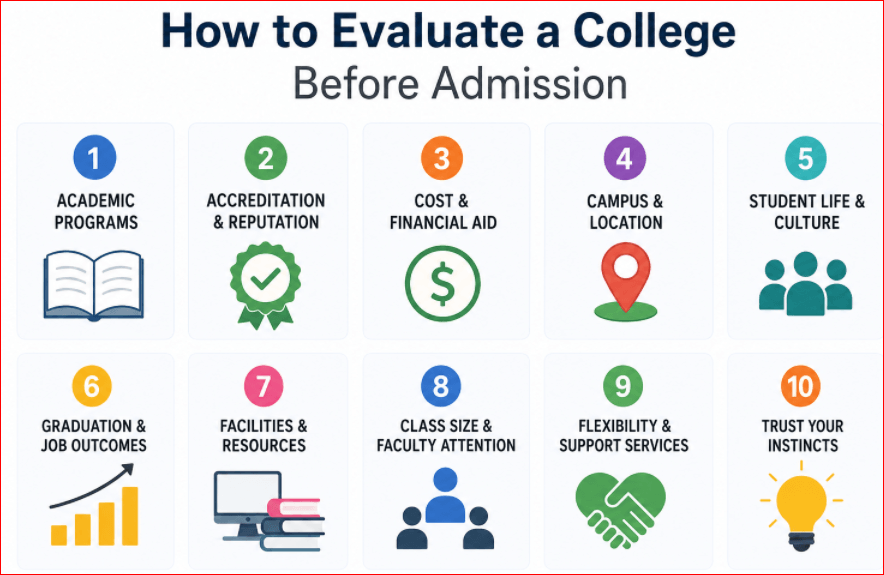
Absolutely. A college ranked 80 overall but known as a strong feeder for the field you want to enter is a better choice than a college ranked 20 overall with weak outcomes in your specific area. Rank is a blunt instrument — career outcomes in your target field are a precise one.
Q6. How do I know if a college’s industry connections are real or just on paper?
Check for evidence of activity, not just claims. Look at the college’s event calendar for guest lectures and workshops in the last 12 months. Check LinkedIn for recent alumni in relevant roles. Review the placement cell’s social media for actual recruiter names. MoUs listed on a website that show no corresponding activity are largely decorative.
Choosing a college based on your career goal rather than your marks is not just a smarter approach — it is a more honest one. It forces you to ask what you actually want from the years ahead, rather than letting a cutoff list make that decision for you. The students who end up doing work they find meaningful are not necessarily the ones who got the highest scores. They are usually the ones who thought most carefully about what they were choosing — and why.
Latest Blog Post




How to Choose the Right College After 12th in India
06 Jun, 2026