Why Choosing the Right College Matters (More Than You Think)
Every year, over 1.5 crore students appear for Class 12 board exams in India. A vast majority will face the same question shortly after: “Which college should I join?” And yet, most will make this four-year decision in four rushed days — going by peer pressure, college name, or their parents’ preference.
The college you attend shapes far more than your degree. It determines the quality of faculty who mentor you, the peer network you build, the internship and placement opportunities available to you, and crucially — your sense of identity and confidence over four critical years.
| Statistic | Finding |
|---|---|
| Students who regret their college choice within Year 1 | 57% |
| Graduates who say college brand impacted their first job | 43% |
| Average time to feel the full impact of a wrong choice | 4 Years |
| New private colleges opened in India since 2018 | 1,000+ |
💡 Key Insight: A “good college” doesn’t mean the most famous one — it means the right fit for your stream, budget, career goals, and personal growth. This guide helps you figure that out systematically.
Step 1: Know Your Stream & Career Goal First
Before you even Google “best colleges,” you must answer one question honestly: What do I actually want to do? This isn’t about picking what sounds prestigious — it’s about understanding whether you want to enter the workforce after a Bachelor’s, pursue research, become an entrepreneur, or apply for professional exams like UPSC or CA.
Career Clarity by Stream
| Stream | Career Clarity % | Primary Career Path |
|---|---|---|
| Engineering (B.Tech) | 72% | Software, Core Engineering, Product Management |
| Medical (MBBS) | 85% | Clinical Practice, Research, Public Health |
| Commerce (B.Com) | 58% | Finance, CA, MBA, Banking |
| Arts / Humanities | 34% | Civil Services, Law, Media, Research |
| Science (B.Sc) | 44% | Research, Teaching, Applied Sciences |
| Design / Fine Arts | 61% | UX/UI, Product Design, Animation, Architecture |
⚠️ Warning: Don’t pick a course because your friends chose it or because it seems financially safe. Misaligned interest is the #1 cause of dropout, low grades, and career regret in India’s youth.
Step 2: Make a Budget Plan Before Shortlisting
Money is rarely talked about openly in college admissions, but it’s the single biggest practical constraint for most Indian families. Before falling in love with any college, establish your family’s realistic annual education budget — including tuition, hostel, food, books, travel, and incidentals.
Annual Fee Ranges by College Type
| College Type | Annual Fees | Notes |
|---|---|---|
| State Govt. Colleges | ₹20K – ₹60K/yr | Best value. Affordable fees, often subsidized hostel. Quality varies by state. |
| Deemed Universities | ₹60K – ₹2L/yr | Middle ground. Solid infrastructure, some curriculum autonomy. |
| Mid-tier Private | ₹2L – ₹5L/yr | Varies widely. Always check placements before committing. |
| Top Private / IITs | ₹5L – ₹15L/yr | Premium institutions with strong networks. Scholarships available — always apply. |
Average Annual Budget Breakdown (Tier-2 Private College, ₹3L/yr)
| Expense Category | Share | Approx. Amount |
|---|---|---|
| Tuition Fees | 42% | ₹1,26,000 |
| Hostel / Rent | 25% | ₹75,000 |
| Food | 15% | ₹45,000 |
| Books & Materials | 8% | ₹24,000 |
| Travel | 6% | ₹18,000 |
| Miscellaneous | 4% | ₹12,000 |
💡 Budget Tip: Always ask the admissions office for a “total cost of attendance” breakdown, not just tuition. Hidden charges — exam fees, lab fees, alumni dues, sports fees — can add ₹30,000–₹80,000 annually at private colleges.
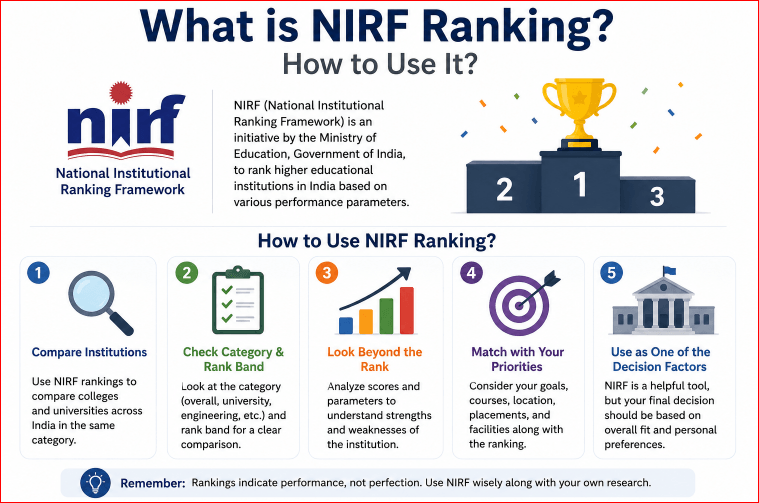
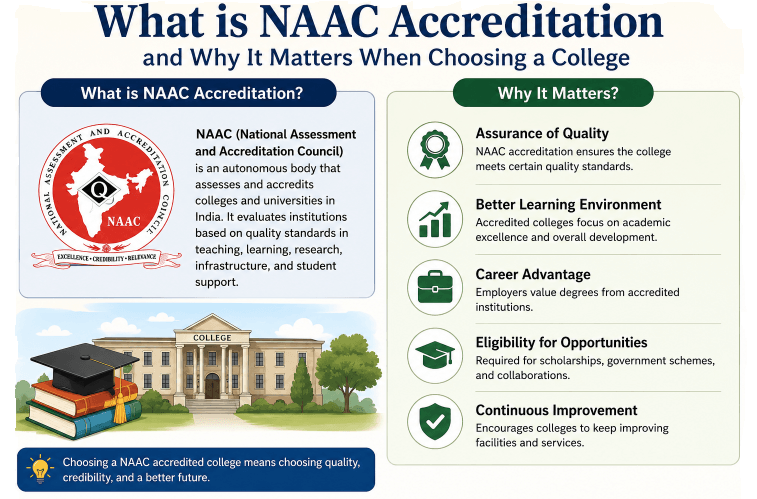
Step 3: Check NAAC Grade and NIRF Ranking
India has two primary quality benchmarks you must check: NAAC accreditation (National Assessment and Accreditation Council) and NIRF ranking (National Institutional Ranking Framework). Both are published publicly and take less than 5 minutes to verify.
NAAC Grades Explained
| Grade | Score Range | Meaning |
|---|---|---|
| A++ | 3.51 – 4.0 | Exceptional — top-tier institutions |
| A+ | 3.26 – 3.50 | Excellent — strong choice |
| A | 3.01 – 3.25 | Very Good — reliable quality |
| B++ | 2.51 – 3.0 | Good — acceptable with research |
| B+ | 2.01 – 2.50 | Average — verify carefully before choosing |
| B / C | Below 2.0 | Avoid — significant quality concerns |
Note: NAAC grades are renewed every 5 years. Always verify the date of accreditation — a college with an A grade from 2015 and no recent re-accreditation may have declined significantly.
NIRF vs NAAC: What Each Measures
| Parameter | NIRF Weightage | NAAC Emphasis |
|---|---|---|
| Teaching Quality | 30% | 35% |
| Research Output | 30% | 15% |
| Placements | 25% | 10% |
| Infrastructure | 10% | 25% |
| Inclusivity | 5% | 15% |
📌 Quick Check: Visit nirfindia.org for NIRF rankings and naac.gov.in for accreditation data. Both are free and searchable by college name. Always verify before visiting a campus.
Step 4: Location — City, State or Hometown?
Location is an underrated factor. Studying in a metro like Delhi, Mumbai, or Bengaluru exposes you to more industry events, internship opportunities, and a diverse peer group — but it also means higher living costs. A hometown college means lower stress and family support but potentially fewer career connections.
| Factor | 🏙️ Metro / Tier-1 City | 🏠 Hometown / Tier-2 City |
|---|---|---|
| Internships & Jobs | More opportunities nearby | Fewer industry connections |
| Peer Network | Diverse, pan-India | Smaller, local |
| Living Cost | Higher | Lower |
| Family Support | Away from home | Nearby support |
| Competition | More competitive | Less peer pressure |
| Faculty Attention | Larger batches | More individual attention |
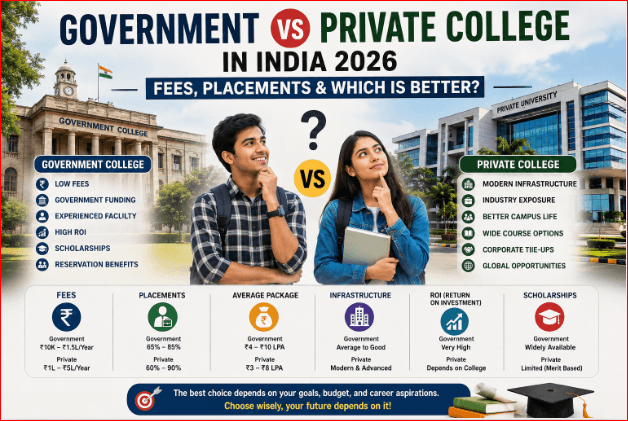
Step 5: Government vs Private College Decision
A top government college beats an average private college every single time. The brand value, subsidized fees, and peer quality at IITs, NITs, DU colleges, or state flagship universities are unmatched for their price point.
| Factor | Government College | Private College |
|---|---|---|
| Annual Fee | ₹10,000 – ₹1,00,000 | ₹50,000 – ₹15,00,000 |
| Faculty Quality | Often highly experienced, govt-vetted | Highly variable by institution |
| Infrastructure | Functional; often outdated | Modern; varies by budget tier |
| Peer Quality | Competitive; merit-based entry | Varies; often management quota |
| Placement | Strong at top govt (IIT/NIT) | Strong at top private (BITS, VIT, etc.) |
| Flexibility | Less — rigid semester systems | More — electives, minors, industry courses |
| Scholarships | Widely available | Available (merit-based) |
| Brand Value | High for premier institutions | Variable — verify via NIRF |
⚠️ Warning: Many private colleges with flashy brochures and high fees have zero UGC recognition or affiliation issues. Always verify a college’s affiliation and UGC status at ugc.ac.in before applying.
Step 6: Check Placement Record and Alumni Network
Placement records reveal the real-world outcome of a college education. Don’t just read the brochure claiming “100% placement” — dig deeper.
Placement Metrics to Verify
| Metric | What to Ask |
|---|---|
| Median Salary | Not the highest package — the middle value. Reflects what a typical student earns. |
| Recruiting Companies | Look for names in your target industry, not just brand names from unrelated sectors. |
| Participation Rate | What % of students opted into placement? 100% of 40% is not “100% placement.” |
| Off-campus Count | Are self-placed students included in stats? Always clarify the methodology. |
| Alumni on LinkedIn | Search the college name on LinkedIn and check actual roles and companies of graduates. |
🔍 Alumni Network Tip: Search the college on LinkedIn, filter by alumni, and check what companies and roles they hold. This 10-minute research tells you more than any admission brochure.
Step 7: Visit the Campus (Or Do a Virtual Tour)
Numbers and rankings can mislead. A campus visit — even a half-day one — reveals things no brochure will: whether students seem genuinely engaged, whether the hostel is livable, whether canteen food is edible, and whether the library is stocked or just decorative.
What to Observe on a Campus Visit
- Check notice boards — are student events active and recent?
- Sit in on a lecture or lab session if permitted.
- Walk to the hostel block unannounced and check real living conditions.
- Test the campus Wi-Fi speed independently.
- Ask a random student (not the assigned ambassador) what they genuinely like and dislike.
- Check the library — is it stocked, digitized, and actively used?
- Visit the placement cell and ask to see last year’s placement report.
If you cannot visit in person, go beyond official videos — search for student-made vlogs and YouTube tours of the campus. Real students show real conditions.
Step 8: Talk to Current Students and Alumni
Nothing replaces a 15-minute conversation with someone currently studying there — or someone who graduated 3–5 years ago. They can tell you about professor quality, exam patterns, hostel reality, and whether the college’s promises match its delivery.
How to Find Students to Talk To
- Search the college on Instagram and LinkedIn.
- Send a polite DM to a student whose profile seems relevant to your course.
- Ask: “What’s the actual placement like for non-toppers?”
- Ask: “How approachable are professors outside class?”
- Ask: “Would you choose this college again knowing what you know now?”
- Connect with graduates 3–5 years out — they have long-term perspective.
✅ The Ultimate College Selection Checklist
| Category | Checklist Item | Done? |
|---|---|---|
| Career & Stream | Identified my top 3 career goals clearly | ☐ |
| Career & Stream | Confirmed the stream aligns with my interest | ☐ |
| Budget | Set a realistic annual education budget | ☐ |
| Budget | Calculated total cost including hostel & food | ☐ |
| Budget | Asked for hidden charges breakdown from admissions | ☐ |
| Quality | Verified NAAC accreditation & date on naac.gov.in | ☐ |
| Quality | Checked NIRF ranking on nirfindia.org | ☐ |
| Quality | Confirmed UGC recognition on ugc.ac.in | ☐ |
| Location & Type | Compared location options (metro vs hometown) | ☐ |
| Location & Type | Decided on govt vs private based on eligibility | ☐ |
| Placements | Checked median placement salary (not just highest) | ☐ |
| Placements | Verified which companies actually recruit on campus | ☐ |
| Placements | Searched alumni on LinkedIn for career outcomes | ☐ |
| Campus & People | Visited campus or watched real student video tours | ☐ |
| Campus & People | Spoken to at least 2 current students directly | ☐ |
| Campus & People | Spoken to at least 1 alumnus about their experience | ☐ |
| Financial Aid | Applied for every eligible scholarship before deadlines | ☐ |
Common Mistakes Students Make When Choosing a College
| Mistake | Why It’s Harmful | How to Avoid It |
|---|---|---|
| Choosing by brand name alone | Famous name doesn’t guarantee good teaching or relevant placements. | Research the specific department, not just the institution. |
| Trusting brochure placement stats | “100% placement” may mean 100% of 40% who opted in. | Ask for median salary and actual participation numbers. |
| Ignoring financial strain | Financial stress directly impacts academic performance. | Choose a college you can afford comfortably. |
| Following friends instead of goals | Your friend’s goals and finances differ from yours. This mistake has a 4-year price tag. | Decide based on your own career path and budget. |
| Not checking UGC status | Hundreds of Indian colleges issue degrees with no legal standing. | Verify on ugc.ac.in before paying any fees. |
| Skipping student conversations | Admissions material is promotional; students tell you the truth. | Talk to at least 2 current students — takes just 15 minutes. |
FAQ: How to Choose College After 12th
| Question | Answer |
|---|---|
| What is the most important factor? | Course-career alignment, realistic budget, and verifiable quality (NAAC/NIRF) form the non-negotiable foundation. |
| Is NAAC A grade enough to judge quality? | No. Always check the date of accreditation alongside the grade. A 2015 A grade with no renewal may not reflect current quality. |
| Should I always prefer govt over private? | Prefer a top govt college over an average private one. But top private colleges (BITS, Manipal, VIT) can match mid-tier govt colleges. |
| How do I verify a placement record? | Ask for the raw report: students registered, placed, median salary, recruiter names. Cross-check on LinkedIn alumni profiles. |
| Can’t visit campus — what to do? | Watch student-made YouTube videos and reels. Connect with current students on LinkedIn or Instagram for an honest conversation. |
| Can I switch colleges after Year 1? | It is possible but difficult. Prevention — choosing right the first time — is always easier than a transfer. |
| How important is location for career? | Very important for tech, finance, and media. Less critical for govt exams, teaching, or healthcare where opportunities are distributed nationally. |
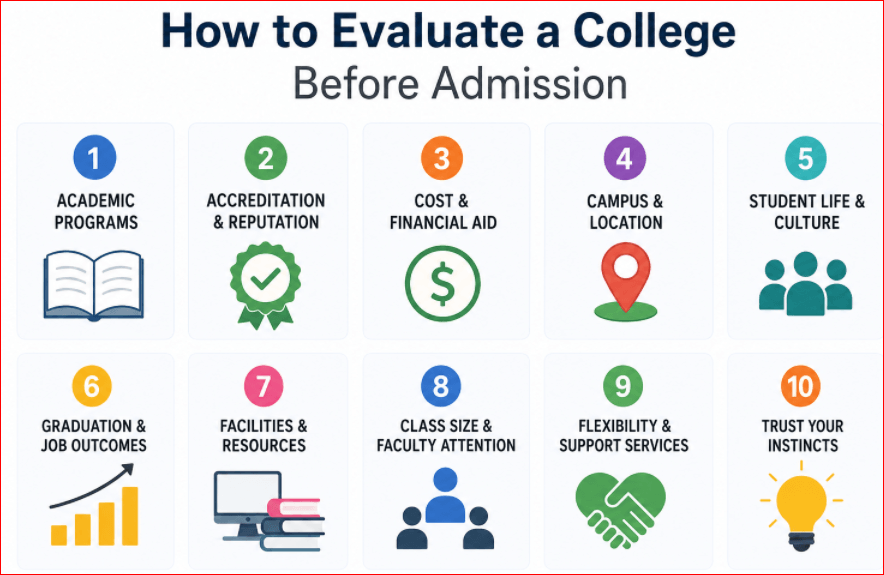
Summary: The 8-Step Decision Framework
Work through these in order — don’t skip to Step 6 before completing Steps 1 and 2.
| Step | Action | Key Focus |
|---|---|---|
| 1 | Career Goal Clarity | What do you actually want to do? Define before searching. |
| 2 | Budget Reality Check | Total cost, not just tuition. Include hidden charges. |
| 3 | NAAC + NIRF Verification | Check accreditation date, not just grade. |
| 4 | Location Decision | Match to industry proximity for your career field. |
| 5 | Govt vs Private | Compare your specific shortlist options side by side. |
| 6 | Placement Deep Dive | Median package, real recruiters, LinkedIn cross-check. |
| 7 | Campus Visit | Go unannounced, check hostel, talk to random students. |
| 8 | Student/Alumni Conversations | Minimum 2 current students + 1 alumnus. |
Information is general guidance for educational purposes. Always verify data from official sources (UGC, NAAC, NIRF).
Latest Blog Post





How to Choose the Right College After 12th in India
06 Jun, 2026