Choosing between a government and private college is one of the biggest decisions students make after Class 12. This article compares fees, placements, faculty, infrastructure, scholarships, reservation policies, and career outcomes to help students make an informed decision.
Introduction: The Big Dilemma Every 12th Student Faces
Every year, millions of Indian students complete their higher secondary education and begin searching for the right college. The question is simple but important: should you choose a government college or a private college? The answer depends on your budget, academic profile, career goals, and preferred learning environment.
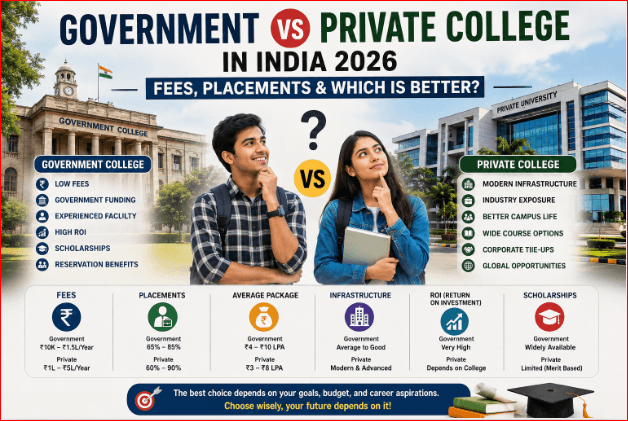
Key Differences: Government vs Private College at a Glance
| Factor | Government College | Private College |
|---|---|---|
| Fees | Lower | Higher |
| Admission | Competitive | Usually Easier |
| Infrastructure | Average to Excellent | Modern |
| Scholarships | Extensive | Limited/Merit Based |
| ROI | High | Varies |
Fee Comparison: Government vs Private (Real Numbers)
| Course | Government College | Private College |
|---|---|---|
| B.Tech | ₹20,000–₹1.5 Lakh | ₹1–₹5 Lakh |
| BBA | ₹10,000–₹70,000 | ₹60,000–₹3 Lakh |
| BCA | ₹10,000–₹80,000 | ₹50,000–₹2.5 Lakh |
| MBA | ₹30,000–₹3 Lakh | ₹2–₹15 Lakh |
Government colleges are significantly more affordable because they receive public funding. For students seeking maximum return on investment, this remains one of the biggest advantages.
Infrastructure and Facilities: Who Wins?
Private colleges often invest heavily in smart classrooms, modern laboratories, digital libraries, innovation centers, hostels, sports complexes, and campus amenities. Government colleges vary widely, with premier institutions offering world-class facilities while some regional colleges continue to modernize.
Faculty Quality: Government vs Private
Government colleges generally recruit faculty through rigorous selection processes and often emphasize research. Private colleges frequently focus on industry exposure and practical learning by hiring professionals with corporate experience.
Placement Records: What the Data Actually Shows
| Placement Factor | Government | Private |
|---|---|---|
| Placement Rate | 65–85% | 60–90% |
| Average Package | ₹4–10 LPA | ₹3–8 LPA |
| Industry Exposure | Moderate | Strong |
Top government institutions such as IITs and NITs deliver exceptional placements. At the same time, several leading private universities maintain strong recruiter networks and internship programs.
Scholarships and Financial Aid: Where Is It Easier to Get?
Government colleges provide access to national and state scholarships, including support for SC, ST, OBC, EWS, minority, and merit-based categories. Private institutions also offer scholarships, but eligibility is often more restrictive.
Reservation and Seat Availability
Government institutions follow reservation policies established by central and state governments. Private institutions may follow different admission models and often include management quota seats.
Real Student Stories: Government vs Private Experience
A government college student may graduate with minimal debt and excellent ROI. A private college student may benefit from superior campus facilities, networking opportunities, and industry engagement. Both paths can lead to successful careers when students make the most of available opportunities.
When Should You Choose a Government College?
- Limited budget
- Strong entrance exam performance
- Need scholarships
- Focus on ROI
- Interest in research and academics
When Should You Choose a Private College?
- Preference for modern infrastructure
- Industry-oriented learning
- Strong campus life
- International exposure opportunities
- Flexible admission options
Final Verdict: Which One is Better for You?
There is no universal winner in the government vs private college India debate. Government colleges generally offer affordability and excellent value, while private colleges often excel in infrastructure and industry exposure. Students should compare accreditation, faculty, placements, curriculum, and affordability before making a final decision.
Frequently Asked Questions
Are government colleges better than private colleges?
Not always. The best choice depends on the institution and your goals.
Which has better placements?
Top government institutions often have stronger placement outcomes, but leading private universities can be equally competitive.
Which is more affordable?
Government colleges are usually far more affordable than private colleges.
Latest Blog Post





How to Choose the Right College After 12th in India
06 Jun, 2026