Every year, around April–June, the Ministry of Education releases a list that sends students, parents, and college administrators into a frenzy — the NIRF Rankings. Some colleges plaster their rank on every banner and hoarding. Others quietly pretend the list does not exist.
But what does the NIRF rank actually tell you? And more importantly — how do you use it intelligently to shortlist the right college, rather than just chasing a number?
This guide answers both of those questions in full.
What is NIRF? Who Publishes It?
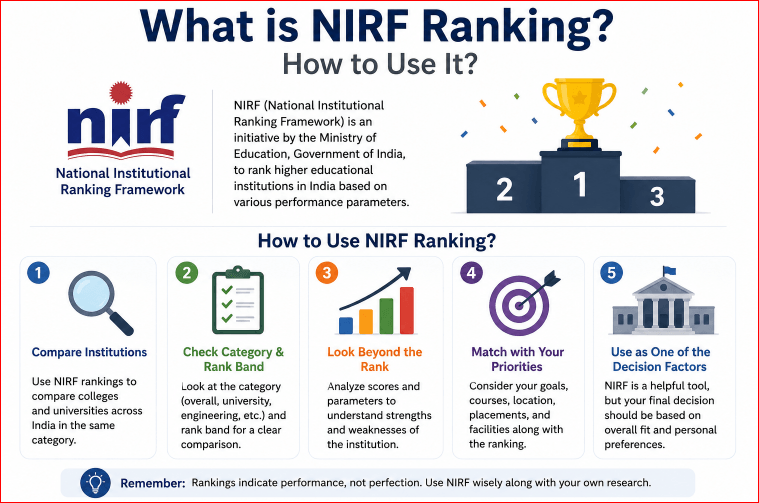
NIRF stands for the National Institutional Ranking Framework. It is India’s official college and university ranking system, launched in 2015 and published every year by the Ministry of Education (formerly MHRD), Government of India.
Unlike NAAC, which is run by an autonomous council, NIRF is a direct government initiative. Institutions submit their data voluntarily, and a central committee evaluates them using a standardised methodology. The rankings are released category-wise — meaning an engineering college is ranked only against other engineering colleges, not against medical or law schools.
NIRF is currently India’s most comprehensive and widely referenced institutional ranking system. It covers over 5,500 institutions across more than a dozen categories.
How NIRF Ranks Colleges: 5 Parameters Explained
NIRF does not rank colleges on a single factor. It uses a five-parameter framework, each carrying a specific weightage. Understanding these parameters helps you interpret what a rank actually reflects — and what it does not.
| Parameter | What It Measures | Weightage |
|---|---|---|
| Teaching, Learning & Resources (TLR) | Faculty-student ratio, faculty qualifications, expenditure on academics, PhD faculty percentage | 30% |
| Research & Professional Practice (RPC) | Research publications, citations, patents filed, funded projects, consultancy income | 30% |
| Graduation Outcomes (GO) | PhD output, placement rate, median salary of placed graduates, higher studies progression | 20% |
| Outreach & Inclusivity (OI) | Percentage of women students, SC/ST/OBC enrollment, economically weaker section representation, differently-abled students | 10% |
| Perception (PR) | Academic reputation score based on peer feedback from faculty, employers, and researchers across India | 10% |
Notice that 60% of the score comes from teaching quality and research output. This makes NIRF particularly strong at identifying institutions that are academically active and well-resourced — but it also means colleges that are strong on placements but weak on research may rank lower than expected.
NIRF Categories: Engineering, Medical, Law, Arts, and More
One of the most useful features of NIRF is that it ranks institutions within their own discipline. A general “Overall” list exists, but the category-specific lists are far more useful when you are looking for a particular course.
| NIRF Category | Useful For Students Seeking |
|---|---|
| Overall | General comparison across all institution types |
| Universities | Central, State, Deemed universities |
| Colleges | Undergraduate Arts, Science, Commerce colleges |
| Engineering | B.Tech / B.E. programmes |
| Management | MBA / PGDM programmes |
| Medical | MBBS, BDS, Nursing, Allied Health |
| Pharmacy | B.Pharm, M.Pharm programmes |
| Law | LLB, BA LLB, integrated law degrees |
| Architecture & Planning | B.Arch, Urban Planning |
| Dental | BDS, MDS programmes |
| Agriculture & Allied Sectors | B.Sc Agriculture, Horticulture, Forestry |
| Innovation | Startup culture, incubation, entrepreneurship focus |
| Open Universities | Distance education institutions |
| Skill Universities | Vocational and skills-based degree programmes |
| State Public Universities | State-funded universities specifically |
Tip: Always look at the category-specific rank rather than the Overall rank. A college ranked 150 Overall but ranked 12 in Law is a very strong law school — the overall number alone hides that information.
How to Read the NIRF Website (Step-by-Step)
The NIRF portal is straightforward once you know where to look. Here is how to get the most out of it in under five minutes:
- Go to nirfindia.org
- On the homepage, click “Ranking 2026” (or the latest year available)
- Select your category from the dropdown — Engineering, Law, Medical, Colleges, etc.
- The ranked list appears with scores broken down by all five parameters
- Click any institution name to see its detailed score card
- Use the State filter on the left to narrow results to your preferred state
- Download the PDF or Excel file for offline reference while shortlisting
On the detailed score card, pay close attention to Graduation Outcomes (GO) — this is where placement rates and median salaries are reported. A college that scores high on TLR but low on GO may be strong academically but weak on employment outcomes, which matters a great deal for professional courses.
NIRF Ranking vs NAAC Grade: Which Matters More?
This is a question almost every student asks when evaluating colleges. The short answer: they serve different purposes, and you need both.
| Aspect | NAAC Grade | NIRF Rank |
|---|---|---|
| Primary Purpose | Accreditation — does the college meet quality standards? | Ranking — how does it compare to peers? |
| Frequency | Every 5 years | Every year |
| Participation | Voluntary, but strongly encouraged | Voluntary |
| What It Tells You | Quality baseline, governance, infrastructure | Relative strength in teaching, research, placements |
| Best Used As | A minimum threshold check | A comparison tool after clearing the threshold |
| Covers Smaller Colleges? | Yes — accreditation is accessible to all | Partially — smaller colleges often don’t submit data |
The practical approach: use NAAC as a filter, use NIRF as a compass. First, verify that any college you are considering holds at least a valid NAAC B++ or above. Then use NIRF to compare shortlisted colleges within your specific discipline and make your final decision based on rank, score breakdown, and state preference.
Limitations of NIRF Ranking You Should Know
NIRF is useful, but it is not a perfect system. Being aware of its limitations will stop you from over-relying on it — or being misled by it.
1. Participation is Voluntary
Many excellent colleges — especially strong regional institutions — simply do not submit data to NIRF. Their absence from the list does not mean they are poor colleges. It may just mean they have not prioritised ranking submissions.
2. Research Weightage Disadvantages Teaching-Focused Colleges
Since research output accounts for 30% of the score, colleges that focus primarily on undergraduate teaching and placement — without a significant research wing — will always rank lower than research universities. This skews rankings against strong professional colleges that produce excellent graduates but fewer journal papers.
3. Data is Self-Reported
Institutions submit their own data. While NIRF does perform verification checks, there is room for selective reporting or inflated figures — particularly in placement statistics and salary numbers.
4. Rankings Shift Every Year
A college ranked 45 this year may be ranked 60 next year — or vice versa. A single year’s rank should not be treated as a definitive verdict. Look at the trend over 3–4 years for a more reliable picture.
5. No Discipline-Level Depth
NIRF ranks the institution as a whole within a broad category. A college ranked 20 in Engineering may have an outstanding Computer Science department but a very weak Civil Engineering programme. NIRF cannot tell you that — you need to dig deeper through faculty profiles and placement data by branch.
Top 10 NIRF Ranked Colleges in Each Category (2026)
Note: Rankings reflect the 2026 NIRF results published by the Ministry of Education. Always confirm the latest rankings at nirfindia.org as these are updated annually.
Engineering
| Rank | Institution | State |
|---|---|---|
| 1 | IIT Madras | Tamil Nadu |
| 2 | IIT Delhi | Delhi |
| 3 | IIT Bombay | Maharashtra |
| 4 | IIT Kanpur | Uttar Pradesh |
| 5 | IIT Roorkee | Uttarakhand |
| 6 | IIT Kharagpur | West Bengal |
| 7 | IIT Guwahati | Assam |
| 8 | IIT Hyderabad | Telangana |
| 9 | NIT Trichy | Tamil Nadu |
| 10 | IIT Indore | Madhya Pradesh |
Management (MBA)
| Rank | Institution | State |
|---|---|---|
| 1 | IIM Ahmedabad | Gujarat |
| 2 | IIM Bangalore | Karnataka |
| 3 | IIM Calcutta | West Bengal |
| 4 | IIM Kozhikode | Kerala |
| 5 | IIM Lucknow | Uttar Pradesh |
| 6 | IIT Delhi (DMS) | Delhi |
| 7 | IIM Indore | Madhya Pradesh |
| 8 | XLRI Jamshedpur | Jharkhand |
| 9 | IIT Bombay (SJMSOM) | Maharashtra |
| 10 | IIM Tiruchirappalli | Tamil Nadu |
Medical
| Rank | Institution | State |
|---|---|---|
| 1 | AIIMS New Delhi | Delhi |
| 2 | PGIMER Chandigarh | Chandigarh |
| 3 | CMC Vellore | Tamil Nadu |
| 4 | JIPMER Puducherry | Puducherry |
| 5 | Amrita School of Medicine | Tamil Nadu |
| 6 | NIMHANS Bengaluru | Karnataka |
| 7 | SGPGI Lucknow | Uttar Pradesh |
| 8 | Kasturba Medical College, Manipal | Karnataka |
| 9 | Sri Ramachandra Institute | Tamil Nadu |
| 10 | AIIMS Jodhpur | Rajasthan |
Law
| Rank | Institution | State |
|---|---|---|
| 1 | National Law School of India University (NLSIU) | Karnataka |
| 2 | NLU Delhi | Delhi |
| 3 | NALSAR University of Law | Telangana |
| 4 | WBNUJS Kolkata | West Bengal |
| 5 | NLU Jodhpur | Rajasthan |
| 6 | Gujarat National Law University | Gujarat |
| 7 | Symbiosis Law School Pune | Maharashtra |
| 8 | Jamia Millia Islamia (Faculty of Law) | Delhi |
| 9 | RGNUL Punjab | Punjab |
| 10 | Christ University (School of Law) | Karnataka |
Arts & Science (Colleges Category)
| Rank | Institution | State |
|---|---|---|
| 1 | Miranda House | Delhi |
| 2 | Lady Shri Ram College for Women | Delhi |
| 3 | Loyola College | Tamil Nadu |
| 4 | St. Xavier’s College (Autonomous) | Tamil Nadu |
| 5 | Presidency College | Tamil Nadu |
| 6 | PSGR Krishnammal College for Women | Tamil Nadu |
| 7 | Atma Ram Sanatan Dharma College | Delhi |
| 8 | St. Stephen’s College | Delhi |
| 9 | Ramakrishna Mission Vidyamandira | West Bengal |
| 10 | Sri Venkateswara College | Delhi |
How to Use NIRF to Shortlist Your College
A rank number alone is not a shortlisting strategy. Here is a practical, step-by-step approach to using NIRF as part of your actual college selection process:
Step 1 — Choose the Right Category
Go to nirfindia.org and select the category that matches your intended course. Do not use the “Overall” ranking for course-specific decisions.
Step 2 — Filter by State (If Needed)
If you prefer to study close to home, or if cost and logistics are a constraint, apply the state filter. Look at the top colleges within your state before jumping to national comparisons.
Step 3 — Look at Score Breakdown, Not Just Rank
Two colleges ranked 30 and 35 might have very similar overall scores but different strengths. A college ranked 35 with a high Graduation Outcomes score may be a better fit for placement-focused students than one ranked 30 with a higher Research score.
Step 4 — Cross-Reference With NAAC
Once you have a shortlist of 5–8 colleges from NIRF, verify each one’s NAAC accreditation status. Remove any that are unaccredited or hold a grade below B++.
Step 5 — Track the Trend
Check whether your shortlisted colleges have been consistently ranked or have been rising or falling over the last 3 years. A college that has moved from rank 80 to rank 45 in three years is investing in improvement — that is a positive signal.
Step 6 — Do Not Stop at NIRF
NIRF gives you a solid starting point, not a final answer. After shortlisting, still visit the campus, speak to current students, verify placement data directly with the placement cell, and check fee structures. NIRF confirms a college is credible — your legwork confirms it is the right fit for you.
NIRF is the most data-driven college comparison tool available to Indian students today. Used correctly — with an understanding of its parameters, categories, and limitations — it can cut through the noise of college marketing and point you toward institutions that have actually earned their reputation.
Use the rank as a starting point, the score breakdown as a lens, and your own research as the final word. That combination will serve you far better than any single number ever could.
Latest Blog Post








How to Choose the Right College After 12th in India
06 Jun, 2026