Every year, millions of students across India shortlist colleges based on brochures, YouTube videos, or advice from relatives. Very few pause to ask one fundamental question: Is this college even accredited?
If you have seen the term NAAC accreditation on a college website and wondered what it actually means — and whether it should influence your admission decision — you are in the right place. This guide breaks it down in plain language, so you can make an informed choice.
What is NAAC? (Simple Explanation for Students)
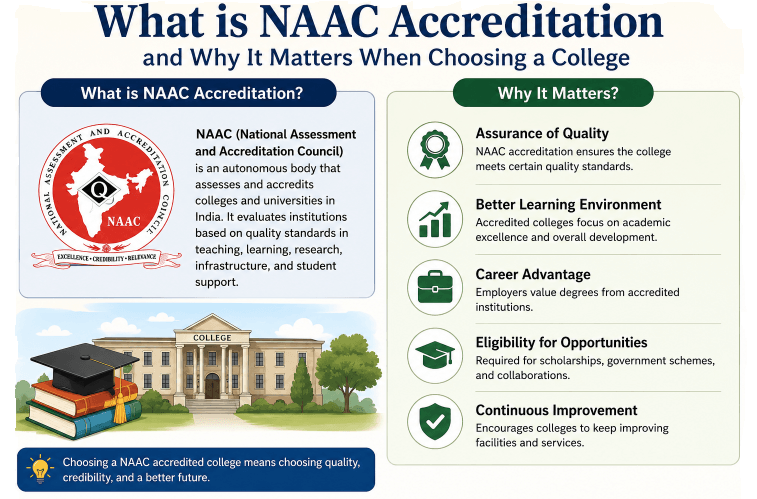
NAAC stands for the National Assessment and Accreditation Council. It is an autonomous body established in 1994 by the University Grants Commission (UGC), headquartered in Bengaluru. Its sole purpose is to assess and accredit higher education institutions across India — universities, colleges, and autonomous institutions alike.
Think of NAAC as a quality auditor for colleges. Just like a restaurant gets health and hygiene ratings, a college gets a NAAC grade based on how well it performs across several dimensions of education quality.
NAAC evaluates institutions on seven criteria:
| Criterion | What It Measures | Weightage |
|---|---|---|
| 1. Curricular Aspects | Course design, relevance, flexibility | 100 marks |
| 2. Teaching-Learning & Evaluation | Faculty quality, student outcomes, assessments | 350 marks |
| 3. Research, Innovations & Extension | Publications, patents, community outreach | 120 marks |
| 4. Infrastructure & Learning Resources | Labs, library, classrooms, hostel, sports | 100 marks |
| 5. Student Support & Progression | Scholarships, placements, mentoring, alumni | 130 marks |
| 6. Governance, Leadership & Management | Administration quality, financial health, transparency | 100 marks |
| 7. Institutional Values & Best Practices | Gender equity, environment, social responsibility | 100 marks |
A NAAC peer team visits the college, evaluates it against these criteria, and assigns a CGPA and a letter grade. The accreditation is valid for 5 years, after which the institution must apply for re-accreditation.
How NAAC Grades Colleges: A++ to C
NAAC uses a 7-point grading scale. The higher the grade, the better the institution’s overall quality. Here is the complete breakdown:
| NAAC Grade | CGPA Range | Status | Student Interpretation |
|---|---|---|---|
| A++ | 3.51 – 4.00 | Accredited | ✅ Outstanding – Among the best in India |
| A+ | 3.26 – 3.50 | Accredited | ✅ Excellent – Highly recommended |
| A | 3.01 – 3.25 | Accredited | ✅ Very Good – Strong choice |
| B++ | 2.76 – 3.00 | Accredited | 🟡 Good – Check other factors too |
| B+ | 2.51 – 2.75 | Accredited | 🟡 Average – Dig deeper before deciding |
| B | 2.01 – 2.50 | Accredited | 🟠 Below Average – Proceed with caution |
| C | 1.51 – 2.00 | Accredited | 🔴 Weak – Consider alternatives |
| D / Not Accredited | Below 1.50 / N/A | Not Accredited | 🚩 Major Red Flag – Avoid if possible |
The A++ grade is the highest honour a college can receive under NAAC’s framework. As of 2024, only a small number of institutions across India hold this distinction — which makes it a genuinely meaningful signal of quality.
Why NAAC Grade Matters for Your Degree
The NAAC grade is not just a badge on the college website. It has direct, practical consequences for you as a student — both during college and after graduation.
1. UGC Grants and Government Funding
Colleges with NAAC accreditation (especially A or above) are eligible for special grants from UGC under schemes like RUSA (Rashtriya Uchchatar Shiksha Abhiyan). This means better infrastructure, more scholarships, and improved facilities funded directly by the government.
2. Autonomous Status and Curriculum Flexibility
NAAC-accredited colleges with high grades can apply for autonomous status, which allows them to design their own syllabus, conduct exams independently, and offer more industry-relevant courses — without being tied to a slow-moving university system.
3. Validity for Government Jobs and Higher Studies
Several state government job portals, UPSC, and banking recruiters require candidates to have degrees from UGC-recognised, NAAC-accredited institutions. Some postgraduate entrance exams and foreign university applications also ask for the NAAC grade of your undergraduate college.
4. Employer Perception
In campus recruitment, HR teams from large corporations often have internal lists of approved colleges. NAAC accreditation — particularly A++ and A+ — is frequently a filtering criterion. A higher-graded college increases your chances of even being shortlisted.
5. A Proxy for Overall Quality
Because NAAC evaluates faculty, infrastructure, governance, research, and student support all together, a high grade is a reasonable signal that the college is functioning well across the board — not just in one department.
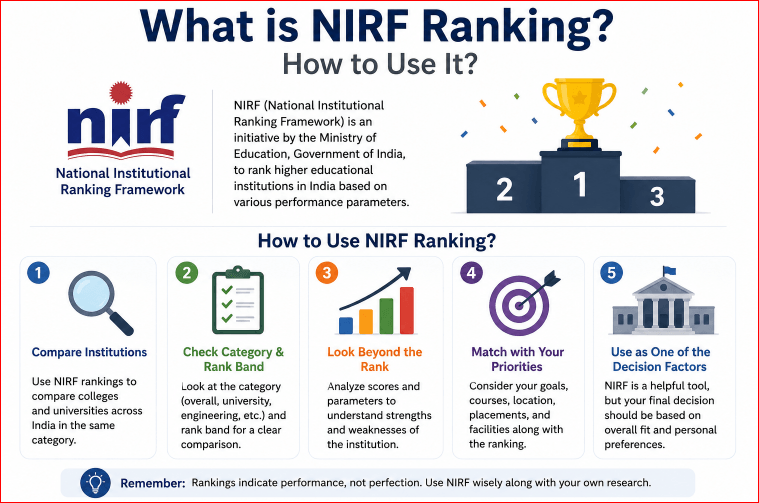
NAAC vs NIRF: What’s the Difference?
Students often confuse NAAC with NIRF. They are related but serve different purposes. Here is a clear comparison:
| Parameter | NAAC | NIRF |
|---|---|---|
| Full Name | National Assessment and Accreditation Council | National Institutional Ranking Framework |
| Set Up By | UGC (1994) | Ministry of Education (2015) |
| Purpose | Accreditation – Pass/Fail + Grade | Ranking – Position among peers |
| Output | Letter Grade (A++ to C) | Rank number (1, 2, 3…) |
| Frequency | Every 5 years (on reaccreditation) | Annually published |
| Focus Areas | Quality assurance, governance, infrastructure | Teaching, research, graduation outcomes, perception |
| Mandatory? | Not mandatory, but strongly encouraged by UGC | Voluntary participation |
| Best Used For | Checking baseline quality & legitimacy | Comparing colleges within a discipline |
Bottom line: Check NAAC first to ensure a college meets a quality baseline. Then use NIRF to compare it against similar colleges in your chosen field.
How to Check a College’s NAAC Grade Online
Verifying a college’s NAAC status takes less than two minutes. Here is how to do it:
- Visit naac.gov.in
- Click on “Accredited Institutions” from the top navigation menu
- Use the search filters: Institution Type, State, Grade
- Search the college name and click on the result
- You will see the CGPA, Grade, Cycle Number, and Validity Date
Important things to verify on the NAAC portal:
- ✅ Validity Date — Is the accreditation still active? An expired NAAC grade is essentially meaningless.
- ✅ Cycle Number — A college in its 3rd or 4th cycle has a long track record of accreditation, which is more reliable than a first-cycle grade.
- ✅ Institution Name Spelling — Some colleges falsely advertise a grade. Always verify the exact registered name on the portal, not just what the brochure claims.
⚠️ Red Flag: If a college claims to be NAAC-accredited but does not appear on the official portal — or the accreditation has expired — do not take their word for it. Walk away.
Does a Non-NAAC College Degree Have Value?
This is one of the most common questions from students in tier-2 and tier-3 cities where many local colleges are not yet accredited. The honest answer is: it depends — but the risks are real.
A degree from a non-NAAC college is not automatically fake or worthless. If the college is affiliated to a UGC-recognised university and operating legally, the degree is technically valid. However, here is what students from non-NAAC colleges often face:
- Disqualification from certain government jobs that require NAAC accreditation as an eligibility criterion
- Rejection in campus recruitment from companies that filter by accreditation status
- Ineligibility for UGC-funded scholarships and research grants that require the parent institution to be accredited
- Difficulty in foreign university applications where NAAC grade is used to assess institutional quality
- Lower credibility on the CV compared to candidates from accredited institutions
If the only college available to you is non-NAAC, make sure it is at least UGC-recognised and university-affiliated. Plan to supplement your degree with certifications, internships, and skill-building programmes that demonstrate your competence independently.
Top NAAC A++ Colleges in India
As of the latest NAAC data, the following institutions hold the prestigious A++ grade — the highest level of accreditation in India:
| Institution | Type | State | Known For |
|---|---|---|---|
| Indian Institute of Science (IISc) | Central University | Karnataka | Science & Research |
| Jawaharlal Nehru University (JNU) | Central University | Delhi | Social Sciences, Humanities |
| Banaras Hindu University (BHU) | Central University | Uttar Pradesh | Multi-disciplinary |
| Amrita Vishwa Vidyapeetham | Deemed University | Tamil Nadu | Engineering, Medicine |
| Savitribai Phule Pune University | State University | Maharashtra | Science, Technology |
| Jadavpur University | State University | West Bengal | Engineering, Arts |
| University of Hyderabad | Central University | Telangana | Sciences, Social Sciences |
| Loyola College | Autonomous College | Tamil Nadu | Arts, Science, Commerce |
Note: NAAC grades are reassessed every 5 years. Always verify the current grade and validity on naac.gov.in before making any admission decision.
FAQ on NAAC Accreditation
Q1. Is NAAC accreditation mandatory for all colleges in India?
No, NAAC accreditation is not legally mandatory. However, UGC strongly recommends it and ties several funding schemes and autonomous status eligibility to accreditation. Many state governments have also started making it a requirement for aided colleges.
Q2. How often does a college get re-accredited by NAAC?
Every 5 years. After each cycle, the institution must submit a fresh Self-Study Report (SSR) and undergo a peer team visit for re-evaluation. A college’s grade can go up or down between cycles.
Q3. Can a college fake its NAAC grade?
Some colleges misrepresent or display outdated grades on their websites and brochures. This is why you must always verify directly on naac.gov.in rather than trusting what a college claims in its marketing material.
Q4. Is a B++ NAAC college good enough?
A B++ grade means the college meets basic quality standards but may have gaps in research output, infrastructure, or faculty strength. It is acceptable — but verify placement records, faculty qualifications, and campus facilities independently before deciding.
Q5. Does NAAC grade affect MBA or MS admissions abroad?
Some foreign universities — particularly in the UK, Canada, and Australia — consider the NAAC grade of your undergraduate college as part of their eligibility assessment. A higher grade from your undergraduate college can strengthen your foreign admission application.
Q6. What happens if a college loses its NAAC accreditation?
If a college’s accreditation expires and it does not apply for re-accreditation, it loses its accredited status. Degrees granted during the accredited period remain valid, but new admissions into a non-accredited college carry the same risks as those outlined above.
Q7. Are IITs and IIMs NAAC accredited?
IITs and IIMs are not typically accredited by NAAC because they fall under separate statutory bodies (IIT Act, IIM Act) and are assessed through different frameworks. Their quality is generally benchmarked through international rankings like QS, THE, and NIRF instead.
The NAAC grade is one of the simplest, most reliable filters you can apply when shortlisting a college. It does not tell you everything — placement numbers, faculty quality, and campus culture still matter — but it instantly separates institutions that have undergone independent quality scrutiny from those that have not.
Before you finalise any college, take two minutes on naac.gov.in. That small step could save you three very large years.
Latest Blog Post






How to Choose the Right College After 12th in India
06 Jun, 2026