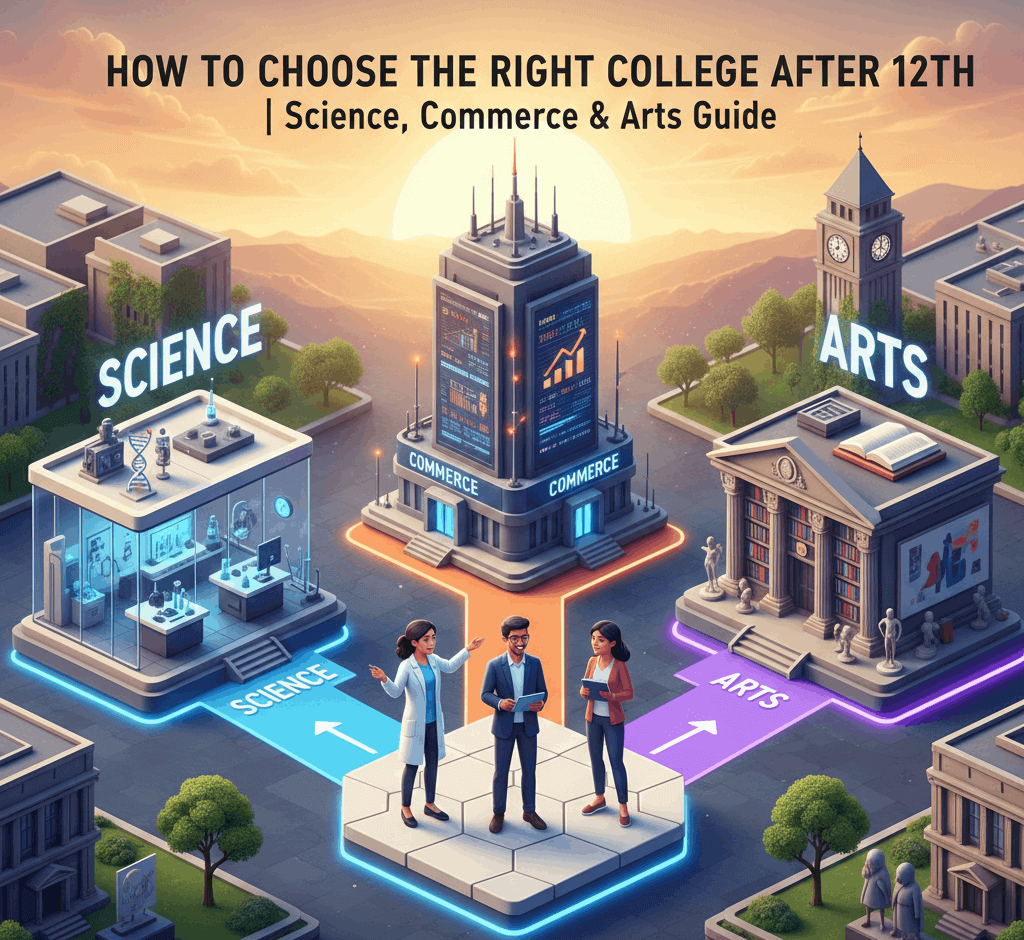
Choosing a college is probably the first “adult” decision you’ll make that has a direct impact on your future. It’s exciting, sure, but let’s be honest—it’s also incredibly overwhelming. You’re moving from the structured world of school uniforms and set schedules into a space that defines your career, your social circle, and your perspective on the world.
Whether you’re a Science enthusiast, a Commerce whiz, or an Arts visionary, the “right” college isn’t just the one with the fanciest building; it’s the one that fits your specific puzzle piece.
Here is a deep dive into how you can navigate this transition smoothly.
1. Start with a Mirror: Identify Your Goals & Interests
Before you start Googling “top colleges,” you need to have a heart-to-heart with yourself. What do you actually want to do when you wake up every morning four years from now?
-
Science Students: Are you chasing a passion for innovation, or are you more interested in the stability of medicine or engineering? If you’re into research, you’ll need a college that prioritizes discovery over rote learning.
-
Commerce Students: Do you see yourself managing a startup, or does the idea of high-stakes stock trading excite you? Your choice between a B.Com and a BBA starts here.
-
Arts Students: Are you looking to influence public policy, or is your heart set on the creative arts?
-
The Takeaway: Don’t pick a college just because your best friend is going there. Your career path is a solo journey; make sure the vehicle you choose can actually get you to your destination.
2. The Credibility Check: Accreditation & Reputation
In the digital age, a flashy website can hide a mediocre education. You need to look under the hood.
-
UGC & NAAC: In India, for instance, the University Grants Commission (UGC) is the gold standard for recognition. Furthermore, look for NAAC (National Assessment and Accreditation Council) grades. An ‘A’ or ‘A++’ rating tells you the institution has passed rigorous checks on teaching quality and infrastructure.
-
National Rankings: While rankings like NIRF or QS aren’t the be-all and end-all, they give you a baseline for where a college stands in terms of research output and perception.
3. The Reality Check: Placement & Internship Records
Let’s talk money and jobs. Most of us go to college to build a career, so the Placement Cell is your most important resource.
-
The “Average” vs. The “Highest”: Colleges love to advertise that one student who got a 1-crore package. Ignore that. Look at the Median Package. That tells you what the “average” student is likely to earn.
-
Company Portfolio: Who is visiting the campus? If you’re in Commerce, are the Big Four accounting firms showing up? If you’re in Science, are tech giants or biotech firms on the list?
-
Internships: A college that mandates internships is doing you a favor. Real-world experience is the only thing that makes your resume stand out in a pile of thousands.
4. The Faculty & Infrastructure: Your Daily Life
You are going to spend 3 to 5 years in these classrooms. The environment matters.
-
The Professors: Check the faculty profiles. Are they published authors? Do they have industry experience, or have they spent their entire lives in academia? You want mentors who know how the “real world” works.
-
The Facilities: * Science: You need high-tech labs. You can’t learn modern physics with 20-year-old equipment.
-
Commerce/Arts: You need massive digital libraries, seminar halls, and high-speed Wi-Fi. The “infrastructure” for you is the access to information.
5. Stream-Specific Advice: Finding Your Niche
The Science Stream
Science is about application.
-
Prioritize Labs: A college with a beautiful garden but a dusty chemistry lab is a bad investment.
-
Industry Research: Look for colleges that have “Industry-Academia” tie-ups. This allows you to work on live projects while you study.
The Commerce Stream
Commerce is about networking and agility.
-
Placement Cells: This is non-negotiable for Commerce.
-
Modern Courses: Ensure the curriculum includes modern modules like FinTech, Data Analytics, or International Business. The old-school ledger-book style of accounting is becoming obsolete.
The Arts Stream
Arts is about perspective and critical thinking.
-
Faculty Diversity: Look for a department that encourages debate and research.
-
Extracurriculars: In the Arts, what you do outside the classroom (theatre, debating, writing) is often just as important as your degree.
6. Financial Planning: Fees & Scholarships
Let’s be practical—college is expensive.
-
ROI (Return on Investment): If a college charges 20 lakhs for a course but the average placement is 4 lakhs, the math doesn’t add up.
-
Scholarships: Don’t be shy about asking for financial aid. Many private universities offer massive discounts for high scorers in 12th grade or entrance exams like CUET, JEE, or NEET.
7. The Final Roadmap: How to Decide
-
Shortlist (The 5-10 Rule): Don’t apply to 50 colleges. Pick 10 that fit your criteria and divide them into “Dream,” “Reach,” and “Safety.”
-
The “Vibe” Check: If possible, visit the campus. Walk into the canteen. Talk to a random student. Websites tell you what the college wants you to see; a 5-minute chat with a current student tells you what the college is.
-
Alumni Network: Use LinkedIn. Search for the college and see where the graduates are working. A strong alumni network is like a “hidden referral system” for your future.
Choosing a college is a balance between Brand Value and Personal Fit. A “Big Name” college might look good on a resume, but if their teaching style doesn’t suit you, you’ll struggle. Choose the place where you feel you can grow, not just graduate.
Latest Blog Post

Best Courses After 12th Science (PCM & PCB) in India
06 Feb, 2026



Branches of Engineering: A Comprehensive Overview
24 Feb, 2024