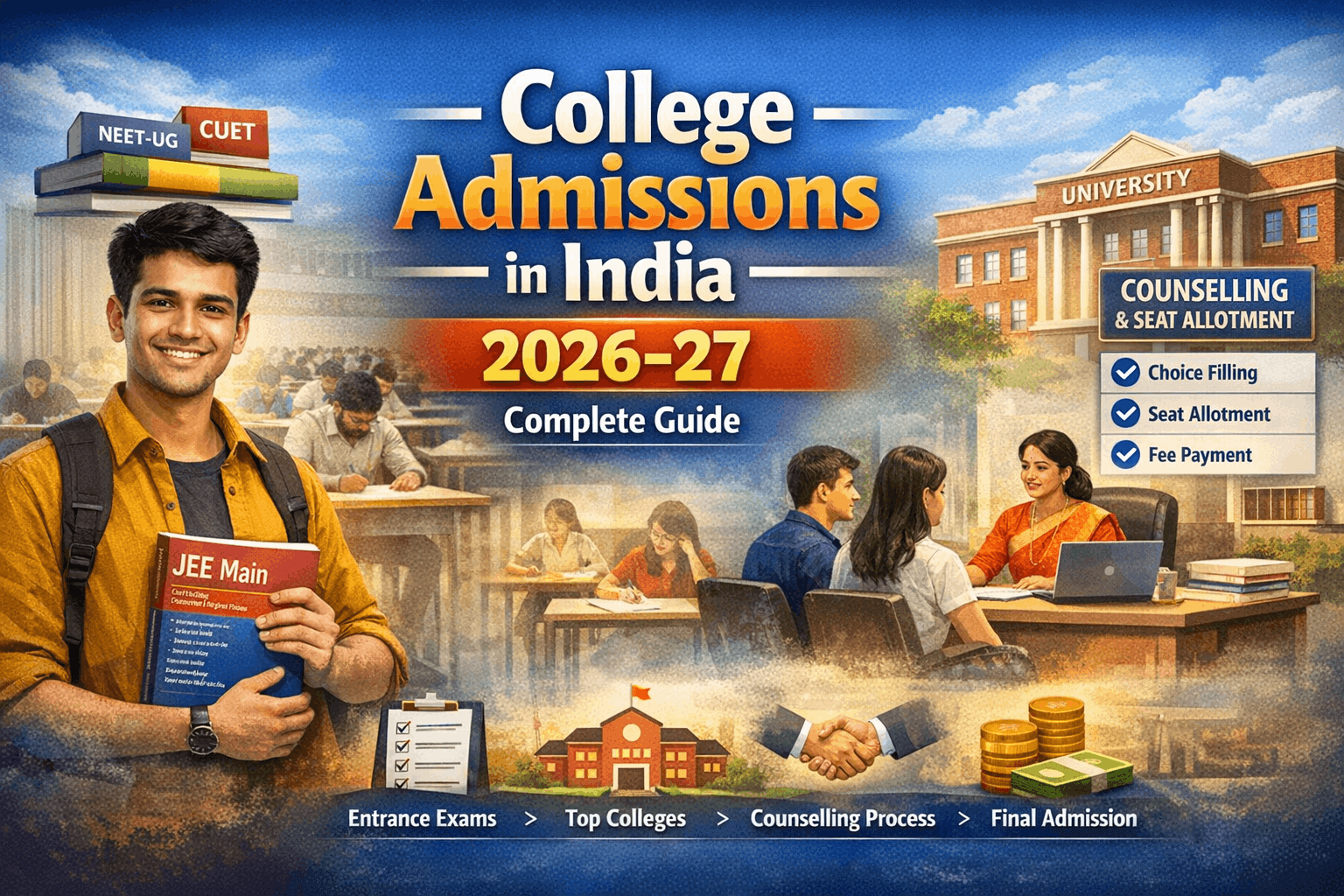
Choosing a college or university after Class 12 is one of the most significant decisions in a student’s life. In India, where more than 3.5 crore students compete for limited quality seats every year, the admission process can feel overwhelming, confusing, and high-pressure. Entrance exams, cut-offs, counselling rounds, quotas, documentation, deadlines—missing even a small detail can cost a full academic year.
With the implementation of the National Education Policy (NEP 2020), the Indian higher education system is undergoing a structural transformation. The focus is shifting from rote learning to skill-based, multidisciplinary, flexible education, making it even more important for students to understand the admission process in depth.
This guide provides a step-by-step, updated, and student-friendly overview of the College and University Admission Process in India for the academic year 2026–27.
Overview of the Indian Higher Education Admission System
India follows a multi-layered admission system, where eligibility, entrance examinations, merit lists, counselling, and institutional policies all play a role.
Broadly, admissions are conducted through:
-
National-level entrance exams
-
University-level entrance tests
-
State-level entrance exams
-
Merit-based admissions (Class 12 marks)
-
Direct / Management quota admissions (mainly in private institutions)
The path a student follows depends on:
-
Course (Engineering, Medical, Arts, Commerce, Law, Management, etc.)
-
Type of institution (Central, State, Deemed, Private)
-
Exam performance
-
Category reservation
-
Availability of seats
Phase 1: Research and Shortlisting – Building the Right Strategy
Before filling out any application form, students must invest sufficient time in research and shortlisting. This phase determines not only admission success but also long-term career satisfaction.
1. Identifying the Right Course
Choosing a course should not be based only on popularity or peer pressure. Instead, it should align with:
-
Student’s aptitude and interest
-
Career goals
-
Market demand
-
Future learning flexibility under NEP
Popular Course Categories in 2026–27
STEM & Technology
-
B.Tech / B.E. with specializations in:
-
Artificial Intelligence & Machine Learning
-
Data Science & Big Data Analytics
-
Cyber Security
-
Robotics & Automation
-
Green Energy & Renewable Technologies
-
Quantum Computing
-
Medical & Allied Sciences
-
MBBS, BDS
-
BAMS, BHMS
-
B.Sc Nursing, Biotechnology, Physiotherapy
Commerce & Management
-
B.Com (Hons)
-
BBA
-
Integrated MBA (IPM)
-
Finance, Business Analytics, FinTech
Humanities & Liberal Arts
-
BA (Hons) Economics, Political Science, Psychology
-
Multidisciplinary Liberal Arts programs (as per NEP)
-
Economics with Data Science / Statistics combinations
Law
-
Integrated Law courses:
-
BA LL.B
-
BBA LL.B
-
B.Com LL.B
-
2. Evaluating Colleges and Universities
Once the course is identified, the next step is to evaluate institutions objectively.
a) Accreditation & Approval
-
UGC Recognition is mandatory for all universities.
-
AICTE Approval is compulsory for technical and engineering programs.
-
NAAC Grade indicates academic quality (A++, A+, A preferred).
b) Rankings and Performance Metrics
-
NIRF Rankings (by Ministry of Education) for:
-
Teaching quality
-
Research output
-
Graduation outcomes
-
-
QS / Times Higher Education Rankings for global recognition.
c) Placement & Industry Exposure
-
Average and highest placement packages
-
Internship opportunities
-
Industry collaborations
-
Alumni network
Phase 2: Entrance Examinations – The Main Selector
In India, Class 12 marks usually determine eligibility, while entrance exams decide selection.
Why Entrance Exams Matter
-
Standardized evaluation across boards
-
Fair competition
-
Ranking-based seat allocation
-
Gateway to top institutions
Major Entrance Exams for 2026–27
| Stream | Entrance Exam | Conducting Body | Tentative Exam Date |
|---|---|---|---|
| Engineering | JEE Main | NTA | April 2026 |
| Engineering (Top Institutes) | JEE Advanced | IITs | May 2026 |
| Medical | NEET-UG | NTA | May 2026 |
| Central Universities | CUET-UG | NTA | May 2026 |
| Law | CLAT | Consortium of NLUs | Dec 2026 |
| Management | IPMAT / CUET | IIMs / NTA | May–June |
Preparation Strategy
-
Understand syllabus and exam pattern
-
Practice mock tests regularly
-
Focus on accuracy and time management
-
Track percentile-based cut-offs
Phase 3: Application Filing and Documentation
After exams, students must apply to:
-
Counselling portals
-
Individual university admission systems
Most applications are now fully online.
Common Application Portals
-
NTA Portal – CUET, JEE, NEET
-
University Portals – DU, BHU, JNU, etc.
-
Counselling Portals – JoSAA, MCC, CSAS
Essential Documentation Checklist
Students must keep physical and digital copies ready.
Academic Documents
-
Class 10 Marksheet & Certificate
-
Class 12 Marksheet & Certificate
Entrance Exam Documents
-
Admit Card
-
Scorecard / Rank Card
Identity Proof
-
Aadhaar Card (name must match certificates)
School Documents
-
Transfer Certificate (TC)
-
Migration Certificate
Category Certificates (if applicable)
-
SC / ST / OBC-NCL
-
EWS
-
PwD
(Must be in Central Government prescribed format)
Phase 4: Counselling and Seat Allotment
Counselling is the process where seats are allocated based on:
-
Rank
-
Preferences
-
Category
-
Availability of seats
How Counselling Works
-
Registration on Counselling Portal
-
Choice Filling
-
College + Course combinations
-
Order of preference is critical
-
-
Seat Allotment Rounds
-
Decision Options
-
Freeze – Accept and lock the seat
-
Float – Accept but wait for better option
-
Slide – Accept same college, different course
-
Major Counselling Authorities
-
JoSAA / CSAB – IITs, NITs, IIITs
-
MCC – Medical (MBBS/BDS)
-
CSAS (DU) – Delhi University
-
State Counselling Bodies – Engineering & Medical
Phase 5: Final Admission and Fee Payment
Once a seat is allotted, the final steps are time-sensitive.
1. Document Verification
-
Online or physical verification at the institute
-
Any mismatch can lead to cancellation
2. Fee Payment
-
Admission / first semester fee must be paid before deadline
-
Failure = immediate seat forfeiture
3. Admission Confirmation
-
Receipt generation
-
Enrollment number issued
Scholarships and Financial Support
Higher education can be expensive, but several options exist:
Government Scholarships
-
National Scholarship Portal (NSP)
-
Post-Matric Scholarships
-
Merit-based schemes
Institutional Aid
-
Merit-cum-means scholarships
-
Fee waivers
-
Education loans tie-ups
Direct Admission & Management Quota: A Backup Option
If entrance exam results are not favorable, many private universities and colleges offer:
-
Direct admission based on Class 12 merit
-
Management quota seats
Important Precautions
-
Verify UGC approval
-
Check placement records
-
Avoid unverified agents
-
Demand official fee receipts
Common Mistakes Students Must Avoid
-
Missing registration deadlines
-
Incorrect choice filling
-
Ignoring counselling instructions
-
Uploading wrong certificates
-
Paying fees without confirmation
Key Deadlines (As of Feb 1, 2026)
-
CUET-UG Registration: Ends Feb 4, 2026
-
JEE Main April Session: Open till Feb 25, 2026
-
Board Exams (CBSE/ICSE): Starting mid-February
Final Advice for Students & Parents
-
Start early and stay organized
-
Keep multiple backup options
-
Focus on long-term learning, not just brand names
-
Use NEP flexibility to explore interdisciplinary paths
The Indian college admission process is competitive but manageable with proper planning, timely action, and informed decision-making. Understanding each phase—from research to final admission—empowers students to navigate the system confidently and secure a future-ready education in 2026–27.
Latest Blog Post

Best Courses After 12th Science (PCM & PCB) in India
06 Feb, 2026





Branches of Engineering: A Comprehensive Overview
24 Feb, 2024